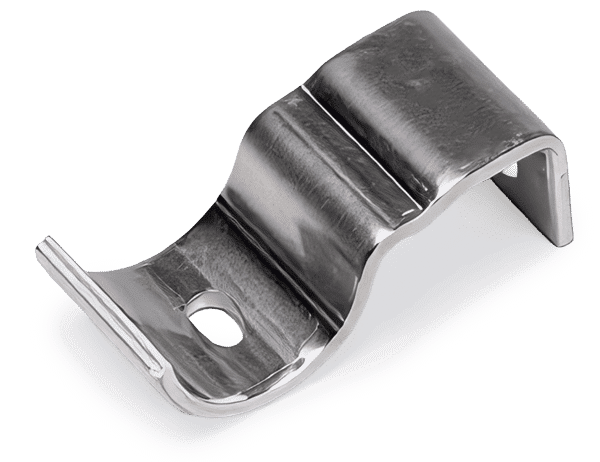
Slide forming, also called 4-slide stamping or multi-slide stamping, is a highly efficient metal stamping process that merges the progressive die process with additional forming stations inside one specialized piece of equipment – using multiple slides and forming tools to produce complex bends, shapes, and features in a single operation. This integration allows Stewart EFI to produce complex, precision-formed parts with exceptional material efficiency and consistency.
Stewart EFI’s slide forming process goes beyond traditional stamping by combining multiple operations in one machine. Our approach creates opportunities to improve part quality, reduce material use, and streamline production, resulting in measurable savings for our customers.
Our 35+ slide forming machines (four-slide, multi-slide, and verti-slide) support complex parts with intricate geometries, multiple bends, and tight tolerances.
By utilizing raw stock edges efficiently, we minimize waste and help reduce material costs while producing cost-effective stamped components.
Sensor-driven quality control combined with our lifetime tooling guarantee helps ensure every part meets demanding specifications.
Our modular tooling and in-house maintenance keep production running reliably.
4-slide and multi-slide forming are well suited for small, complex metal components that require multiple bends, forms, or features from different directions. The process can often produce parts in a single operation that might otherwise require multiple stamping or secondary forming operations.
For OEMs and product engineers, 4-slide stamping can be particularly valuable when part geometry, material utilization, production volume, or the number of required forming operations makes conventional stamping less efficient. Stewart EFI’s engineers can evaluate your part design and recommend the most appropriate metal forming process for your application.

The feed, straightener, and press head work similarly to a progressive die stamping process, but all sub-processes are integrated into one machine along with the forming station. In the press head, features such as cuts, holes, dimples, extrusions, coining, and other part characteristics are produced while the parts remain attached to the strip.
Once sensors confirm proper positioning, a gripper holds the part, which is then cut off from the strip and transferred to the forming station.

The forming station is mounted in the cam-operated area of the machine. Form tooling is mounted on cam-driven slides around a central mandrel (king post or arbor). This mandrel acts as an anvil over which slide punches form bends in the part.
Slides, each fitted with a punch, move simultaneously or in sequence, driven by cams on the machine’s drive shafts. Depending on the machine, four or more slides are fixed at 90-degree intervals around the mandrel (four-slide or multi-slide forming) or positioned anywhere around a 360-degree axis for rotary forming. Machines are available in horizontal and vertical versions depending on the slide direction.
After forming, stripping fingers positively eject the finished part off the mandrel and out of the machine.
Stewart EFI uses 4-slide and multi-slide forming to manufacture precision components from a range of metal materials, depending on the part design, required properties, and application. Materials may include steel, stainless steel, aluminum, copper, brass, and other alloys.
Our engineering team can help determine whether aluminum, steel, or another material is appropriate for your component and production requirements. Contact us today and speak to our team about your 4-slide or multi-slide stamping part design and material options.
4-slide stamping is a metal forming process that uses multiple slides and forming tools to bend, shape, cut, and form metal from different directions. Unlike conventional stamping, which primarily moves tooling vertically, 4-slide equipment uses horizontal or multi-directional tooling to produce complex geometries and multiple bends in a single operation.
4-slide stamping and multi-slide stamping use similar forming principles and are often used interchangeably. A four-slide machine typically uses four forming slides positioned around the workpiece, while multi-slide equipment can incorporate additional forming directions or configurations. The appropriate equipment depends on the geometry and requirements of the part.
4-slide stamping can produce complex bends and formed features from multiple directions while reducing the need for secondary forming operations. Depending on the part design and production requirements, the process can also provide efficient material utilization, repeatable production, and opportunities to consolidate multiple operations into a single manufacturing process.
The most cost-effective process depends on the part geometry, material, production volume, tolerances, and required operations. 4-slide stamping can provide cost advantages for certain complex parts because multiple forming operations can be completed in one machine and material utilization can be efficient. Stewart EFI engineers can evaluate your component and recommend the appropriate process.
4-slide and multi-slide forming can produce a wide range of small, precision-formed metal components, including clips, brackets, retainers, terminals, connectors, springs, clamps, and other components with multiple bends or formed features. The process is particularly useful when a part requires complex geometry or forming from multiple directions.
Stewart EFI works with OEMs and manufacturers to evaluate part geometry, material requirements, production volume, and other specifications to determine whether slide forming is the right manufacturing solution.
4-slide and multi-slide stamping can be used with a variety of metals, depending on the part design, material properties, and equipment requirements. Common materials may include steel, stainless steel, aluminum, copper, brass, and other alloys. Stewart EFI can help determine the appropriate material and forming process for your application.
Yes. Aluminum can be used for multi-slide stamping when the alloy, material thickness, part geometry, and forming requirements are appropriate for the process. Stewart EFI can evaluate an aluminum component’s design and material requirements to determine whether multi-slide stamping is a suitable manufacturing method.
To quote a 4-slide or multi-slide stamped component, a manufacturer will typically need the part drawing or CAD model, material and thickness, tolerances, estimated annual volume, quality requirements, and any required secondary operations or finishing. Providing information about the application’s performance requirements can also help engineers determine the most appropriate manufacturing process.
Stewart EFI specializes in small to medium-sized parts, as well as miniature components manufactured using 4-slide and multi-slide stamping processes. Our slide-forming equipment is well suited for intricate parts with multiple bends, complex geometries, and tight tolerances.
We work with materials ranging from approximately .002″ to .120″ (0.05 mm to 3.0 mm) in thickness, depending on the material and application. Because achievable part size depends on the part’s geometry, material, tolerances, and forming requirements, our engineering team can evaluate your design to determine whether 4-slide stamping is the right manufacturing process.
Yes. Stewart EFI supports prototype quantities through full-rate production, including production-intent prototypes for design validation, testing, and manufacturing development. Our engineering team evaluates the part design, material, tolerances, and production requirements to determine the most appropriate manufacturing process. When a component is well suited to 4-slide or multi-slide stamping, we can support the project through prototyping and production while maintaining a focus on manufacturability, quality, and cost. We also provide deep draw stamping and progressive die stamping for parts better suited to those forming operations.
With decades of experience and one of the largest fleets of slide forming equipment in the industry, Stewart EFI delivers cost-optimized, high-quality components at scale. Our integrated process, sensor-driven quality control, and lifetime tooling guarantee translate into reliable production and significant value for our customers.
Learn how we can help with 4-slide or multi-slide stamping solutions for your next project. Fill out the form on this page or contact a sales representative in your area to discuss your part and application requirements. Our experts can evaluate your part design, material, production requirements and tolerances – and work with you to determine if 4-slide stamping is the right process for your application.