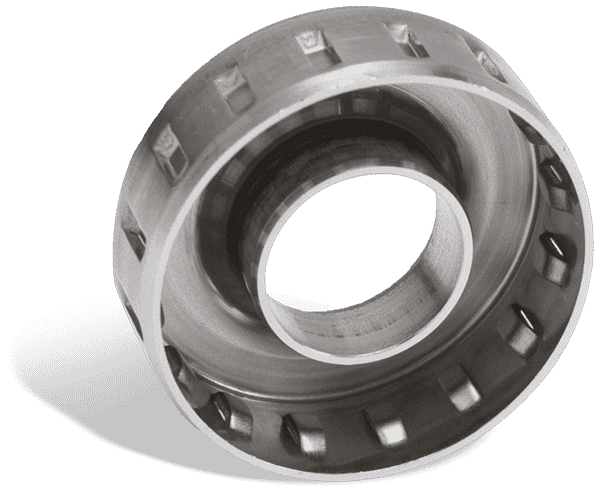
Deep drawn stamping is a precision metal forming process that allows OEMs to produce complex, cylindrical, or enclosed components at high speed with tight tolerances. At Stewart EFI, our expertise in deep drawn stamping spans 90+ years, supporting prototypes and high-volume production runs with defect-free results. Learn how this process delivers efficiency, precision, and cost savings, and explore its rich history.
Using transfer-style presses for deep drawn stamping provides several advantages for OEMs and precision manufacturers:
Blanks are freed from the parent strip material which allows easy formability.
Dwell times at the top and bottom of the stroke allows for other work to be done within the press which are normally costly secondary operations.
Stewart EFI partners with OEMs to deliver defect-free deep drawn stamping components, providing full engineering support from concept through high-volume production. Our approach combines technical expertise, advanced equipment, and integrated quality systems to ensure cost-effective, reliable solutions for complex parts.
Reach out and discover why Stewart EFI is a trusted partner for high-precision deep drawn stamping projects worldwide.
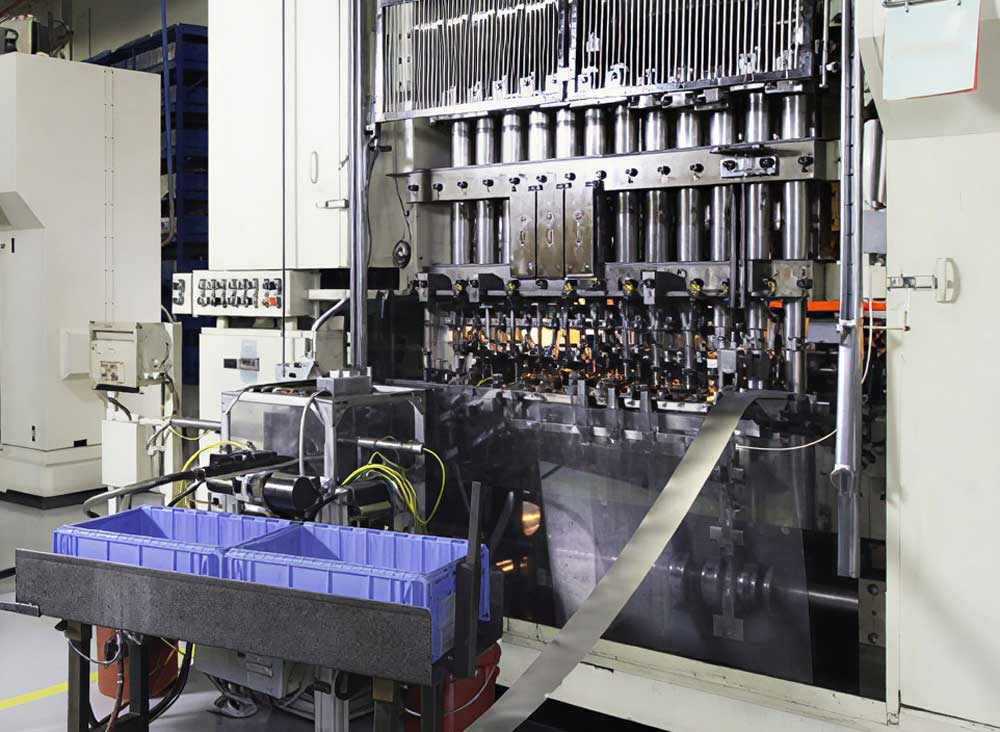
The origins of deep drawn stamping, sometimes called “eyelet” stamping, date back to the 1800s in Connecticut’s Naugatuck Valley. This early history is described in the article below, entitled “Men, Minds & Machines,” written by the Mattatuck Historical Society in 1981. Early transfer presses, or “eyelet machines,” laid the foundation for today’s highly precise deep drawn stamping processes. Over the decades, innovations in press design, tooling, and material handling have allowed Stewart EFI to evolve this historic process into a modern, high-speed solution for complex OEM components:
“Brass is the City of Waterbury” but for it the city would be no city! This sentence began a report in the 1869 Boston Commercial Bulletin describing Waterbury, Connecticut and the general area (the Naugatuck Valley) in its finest time. The eyelet industry is an outgrowth of the brass business which was so prominent in this area in the 19th and early 20th centuries. For decades, Waterbury, Connecticut was known as the “brass city of the world”. The following perspective gives an historical overview of the roots of the eyelet machine. In the late 18th century agriculture in the rocky and sometimes swampy areas around Waterbury was giving way to the Industrial Revolution. The Naugatuck River and Mad River, once used to power sawmills and gristmills were being eyed as power sources for shops and waterways to markets. Farmer’s sons turned into craftsmen using their hands to form metal and wood rather than till the earth. In the Waterbury area, two businesses began the first steps into the Industrial Revolution. The clock field was pioneered by Eli Terry in 1793, while Abel and Levi Porter began producing metal buttons in 1802. Both industries required brass which was very malleable for the crude tools of the day. The formation of buttons became more sophisticated as the original Porter business was sold to Frederick Leavenworth, David Hayden and J.M. Scovill in 1811. This company eventually became the Scovill Manufacturing Company.
In the early 1800’s the growing need for forming brass evolved because of the introduction of gas lighting. The demand for tubing and lamps for public and private gas lighting became another offshoot of brass forming technology.
The need for more workable forms of brass led Aaron Benedict and Alfred Platt to import heavy rolls from England in 1824 and start the Platt Mills Company. These rolls were utilized to make brass into the more versatile form of sheet. This growing technology for forming brass again came into demand for wire used for electricity, telegraph and telephones.
To complete with more refined methods of brass formation in England, an entire industry of specialized machines was born in the Waterbury area to fabricate brass. This industry was pioneered by Eli and Frank Manville in the mid 1800’s. Eli Manville was considered a natural master mechanic and genius who had gained various experiences by working in many of the local factories. He founded the Eli Manville Company in 1878 and invented such machines as the “Four Slide” and “Hendey Planer and Shaper”. The company continued under son Bob and eventually was sold. While in existence, the company built the first “eyelet” machine, or as it is more correctly called, the transfer press. The machine was built to fabricate brass into reinforcing eyelets for shoes, tents and corsets. Over the years the versatility of the machine became evident and further advances in tool steel and tool design made way for the production of thousands of various shapes and forms. The Waterbury Farrell Company, now a division of Textron, Inc., continued the tradition of the now defunct Manville Company and further refined the mechanical workings of the transfer press.
The last of the large brass fabricators have all but left the Naugatuck Valley. However, its offshoot, the “eyelet” industry and the many eyelet craftsmen, have survived to form the hub of a very unique and prosperous industry. Although some eyelet operations exist outside of this geographic region, the talent for this field is overwhelmingly settled in the Naugatuck Valley, the birthplace of eyelet technology.
Whether you need prototypes or high-volume production runs, Stewart EFI combines deep technical expertise, advanced equipment, and integrated quality systems to deliver reliable deep drawn stamping solutions. Contact us to discuss how our process can optimize your next component design.